
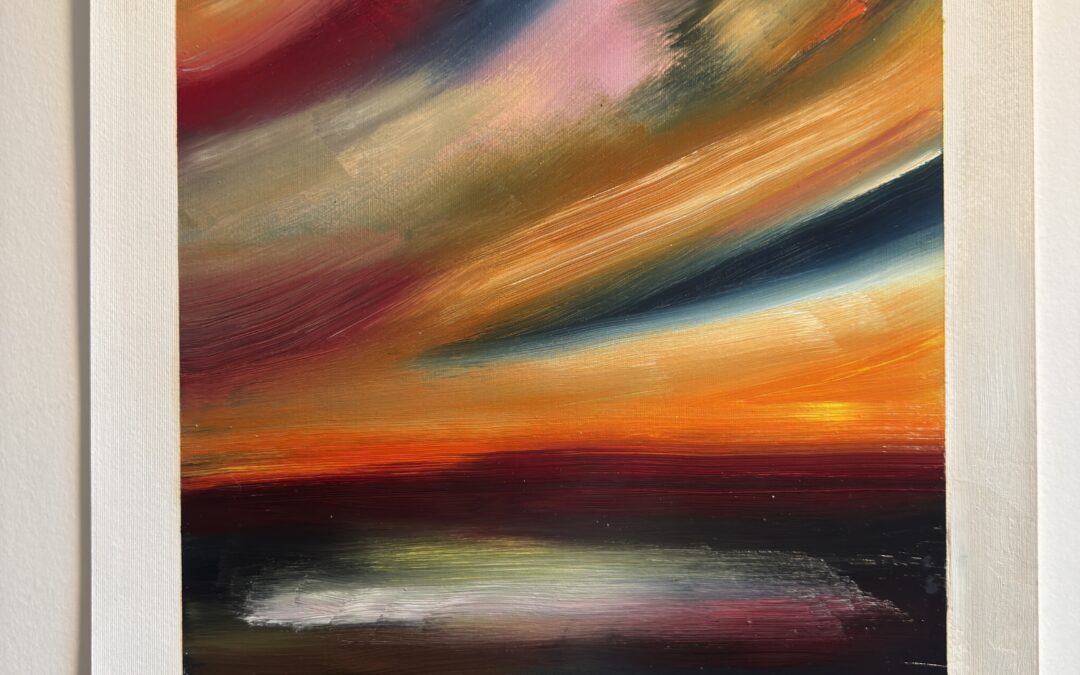
Abstract landscapes are not depictions of places; they are translations of experience. They exist in the space between what is seen and what is felt, between geography and memory. The artwork shown here — a composition built from layered horizontal bands of colour — is a powerful example of how abstract landscapes can evoke land, sea, weather, and emotion without relying on literal form.
At first glance, the painting appears simple: bands of deep blue, turquoise, red, green, and darkened shadow move across the surface. Yet the longer one looks, the more complex the experience becomes. This is the quiet strength of abstract landscapes. They unfold slowly, asking the viewer to remain present, to look beyond recognition and into sensation.
This work, titled Irish Landscape (as noted in the inscription), does not attempt to describe a specific place in Ireland. Instead, it captures something more elusive — the feeling of standing before land and water, of light breaking through cloud, of weather shifting across a horizon. It is a landscape remembered rather than recorded.
The Power of the Horizon in Abstract Landscapes
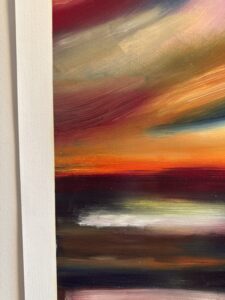
The horizon is one of the most enduring structures in landscape art. Even in abstraction, it continues to exert a psychological pull. Humans are deeply attuned to horizontality; it gives us orientation, balance, and a sense of place in the world.
In this artwork, the horizon is implied rather than drawn. The horizontal bands of colour suggest layers of land, sea, and sky, yet they remain fluid and interchangeable. The deep navy and charcoal tones at the top could be a heavy sky or a distant landmass. The luminous blues beneath suggest water or atmosphere. The vivid red band interrupts the composition like a sudden break in weather — perhaps a sunset, perhaps an emotional surge. Below, greens and darker tones anchor the painting, grounding it in something earthy and physical.
This ambiguity is central to abstract landscapes. The viewer senses a horizon, but cannot locate it precisely. The painting hovers between stability and movement, mirroring the way real landscapes are experienced: never static, always changing.
Colour as Geography
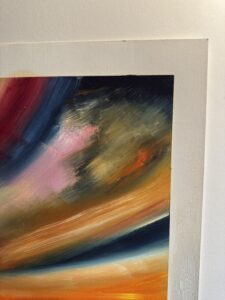
In traditional landscapes, geography is described through line and form. In abstract landscapes, colour takes on this role. Colour becomes terrain. It defines distance, temperature, mood, and scale.
The palette in this work is both restrained and bold. Cool blues and greens dominate, evoking water, rain, and wind — elements closely associated with the Irish landscape. These colours feel expansive and atmospheric, creating a sense of openness and depth. Against this, the intense red band acts as a visual and emotional fulcrum. It draws the eye immediately, cutting across the composition with warmth and urgency.
This red is not decorative. It feels necessary, as if representing a fleeting moment of light or energy — a sunset breaking through clouds, or a memory that refuses to fade. In abstract landscapes, such moments often carry emotional weight. They act as anchors for the viewer’s own associations, inviting personal interpretation.
Gesture and Movement
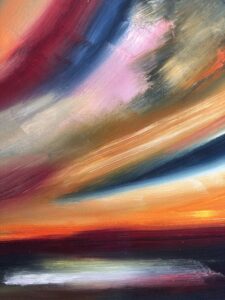
Although the composition is structured around horizontal bands, the surface itself is anything but rigid. Visible brushstrokes sweep across the painting, creating subtle variations within each colour field. These gestures introduce movement and rhythm, preventing the work from becoming static.
This sense of motion is crucial. Landscapes are never still. Wind moves across water, clouds shift, light changes minute by minute. Abstract landscapes capture this dynamism not through depiction, but through process. The act of dragging paint across the surface, allowing colours to blend and resist one another, mirrors natural forces at work.
In this painting, some areas appear smooth and luminous, while others are rougher and more opaque. These contrasts suggest changing conditions — calm and turbulence, clarity and obscurity. The painting feels alive, as if still in motion long after the paint has dried.
Memory, Place, and the Irish Landscape
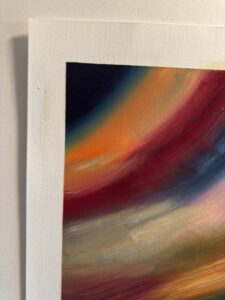
The inscription Irish Landscape immediately frames the work within a cultural and geographical context, yet the painting itself resists specificity. There are no cliffs, no fields, no recognizable landmarks. Instead, the work evokes what might be called the emotional climate of Ireland.
Ireland’s landscape is defined as much by atmosphere as by form. Weather moves quickly. Light can change dramatically within minutes. Sea and land are constantly in dialogue. This painting reflects those qualities through its shifting tones and layered composition.
Abstract landscapes like this one often operate as memory landscapes. They are shaped by repeated encounters with a place over time rather than by a single view. The artist absorbs colours, moods, and rhythms, then releases them onto the surface through intuitive decision-making. The result is not a picture of Ireland, but an echo of it.
The Role of Abstraction in Contemporary Landscape Art
In a world saturated with photographic images, abstraction offers an alternative way of seeing. Abstract landscapes do not compete with photography; they offer something photography cannot — an interior response to the external world.
This artwork exemplifies why abstract landscapes remain relevant today. Rather than presenting a finished narrative, it creates space for contemplation. Viewers are not told what to see or how to feel. Instead, they are invited to slow down and engage with colour, texture, and balance.
This openness makes abstract landscapes deeply personal. One viewer may see a seascape at dusk; another may experience emotional tension or calm; another may simply respond to the harmony and dissonance of colour. Each reading is valid, and each completes the work in a different way.
Light as an Emotional Force
Light is often the silent subject of landscape painting. In abstract landscapes, light is suggested through contrast and luminosity rather than through direct representation.
In this work, light appears to emanate from within the painting rather than falling upon it. The pale turquoise band glows against darker surrounding tones, creating the sensation of light breaking through. The red band intensifies this effect, amplifying the contrast and heightening emotional resonance.
This internal light gives the painting a sense of depth and presence. It feels less like a surface and more like a window — not into a physical place, but into an emotional or psychological space.
Balance and Tension
A successful abstract landscape often relies on a delicate balance between harmony and tension. Too much harmony, and the work becomes decorative. Too much tension, and it becomes chaotic.
Here, balance is achieved through careful distribution of colour and weight. The darker tones at the top and bottom frame the brighter central bands, creating a sense of containment. The red band disrupts this balance just enough to keep the eye moving, preventing the composition from settling into predictability.
This interplay reflects the nature of landscapes themselves. They are places of beauty and calm, but also of unpredictability and force. Abstract landscapes that acknowledge both aspects feel authentic and resonant.
Texture and Time
Close inspection of the surface reveals subtle variations in texture. Some areas show evidence of layered paint, while others appear wiped back or reworked. These traces of process are not hidden; they are integral to the work.
Texture in abstract landscapes often functions as a record of time. Each layer represents a moment — an action, a decision, a response. Over time, these moments accumulate, much like geological layers in the earth.
This temporal quality adds depth to the viewing experience. The painting is not just something to look at; it is something that has happened. It carries within it the memory of its own making, echoing the slow, accumulative processes that shape real landscapes.
Why Abstract Landscapes Endure
Abstract landscapes endure because they speak to something fundamental in human experience: our relationship with place. Even in increasingly urban and digital lives, we remain deeply connected to land, sea, and sky.
Works like this one remind us that landscapes are not just external environments; they are internal states. They shape our moods, our memories, and our sense of self. By removing literal detail, abstract landscapes allow these deeper connections to surface.
On www.peterjosephowens.com, abstract landscapes function as spaces for reflection. They do not demand interpretation; they invite it. They offer viewers the chance to pause, to breathe, and to reconnect with sensations that are often overlooked in daily life.
Conclusion: A Landscape Felt, Not Seen
This abstract landscape is a meditation on colour, movement, and memory. It does not describe a place; it evokes one. Through horizontal bands of shifting colour, layered texture, and subtle gesture, it captures the essence of landscape as experience rather than image.
In doing so, it embodies the enduring power of abstract landscapes. They are not about what the land looks like, but about how it feels to stand within it — to sense weather approaching, light changing, and time passing.
For collectors and viewers alike, abstract landscapes offer something rare: a space to project, reflect, and feel. They are landscapes not of geography, but of perception — open, evolving, and deeply human.
Recent Comments